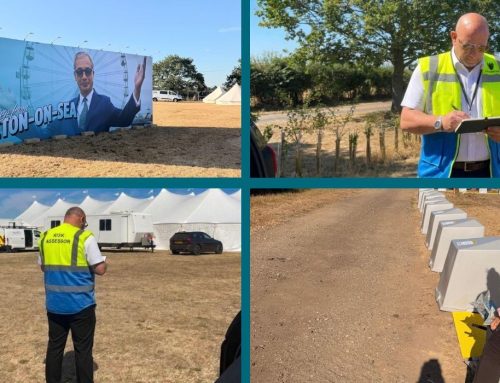
Rory McGoldrick, Co-MD of SAFECROWDS GROUP explains how the company’s in-house Level 5 qualified crowd management professionals help to ensure HVM installations take crowd flows and crowd safety into account.
With vehicles and vehicle-borne attacks increasingly used as terrorist tactics, hostile vehicle mitigation (HVM) plays an important role in protecting pedestrians at locations where crowds are likely to gather and circulate.
Specification of a suitable HVM barrier – rated in line with the identified risk and correctly installed – is essential, but there is more to an effective HVM strategy than the performance of the barrier. If the physical measures installed to protect people disrupt pedestrian movement, create pinch points, or introduce hazards into already crowded spaces, mitigating the risk of vehicle attacks may result in other crowd safety risks. That’s why crowd management expertise should always be part of HVM planning from the outset.
Understanding the risk factors
When we talk about hostile vehicle mitigation, the conversation naturally starts with the threat. What vehicle could be used? At what speed and trajectory? Where are the vulnerable approach routes? What level of protection is required?
These are all essential questions, but they need to be considered in the context of how people actually use the space.
HVM barriers are deployed in environments shaped by pedestrian flows, queues, crossing movements, entrances, exits and changing crowd densities, which is why operational and safety considerations have to be understood and factored into planning.
Protecting people without obstructing them
HVM measures should stop or delay a hostile vehicle while enabling pedestrian movement to continue safely. The principle sounds simple, but, in practice, the balance is more complicated.
Every physical intervention occupies space and, depending on its type, size, orientation and position, it may reduce the usable width of a route, alter natural route selection, divide a crowd into separate channels, or create areas where flows merge and conflict. The impact may be negligible during normal footfall, but it could be much more significant when thousands of people arrive or leave within a short period of time.
For example, a barrier arrangement that presents little difficulty when people can see it and adjust their route may become more problematic when visibility is obscured by the people in front, when groups are moving together, or when spectators are leaving an event simultaneously. Consequently, HVM planning needs to consider more than the available physical space on a plan; it also requires understanding of how the space behaves when people are in it.
It’s not just about the space, it’s about movement
Understanding how HVM barriers affect the movement of people in and through a space requires an understanding of crowd characteristics and behaviours. Where are the natural pedestrian routes? Where do people queue or dwell? Are different flows likely to cross? Are there existing pinch points? Will people be carrying bags, pushing buggies or using mobility aids? Is the crowd likely to be familiar with their surroundings? Could alcohol, poor lighting or weather affect behaviour? What happens during emergency egress?
All these factors influence whether an HVM measure could become a potential pedestrian hazard, as well as mitigating vehicular risks.
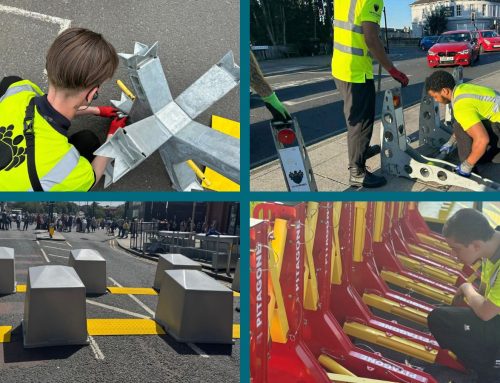
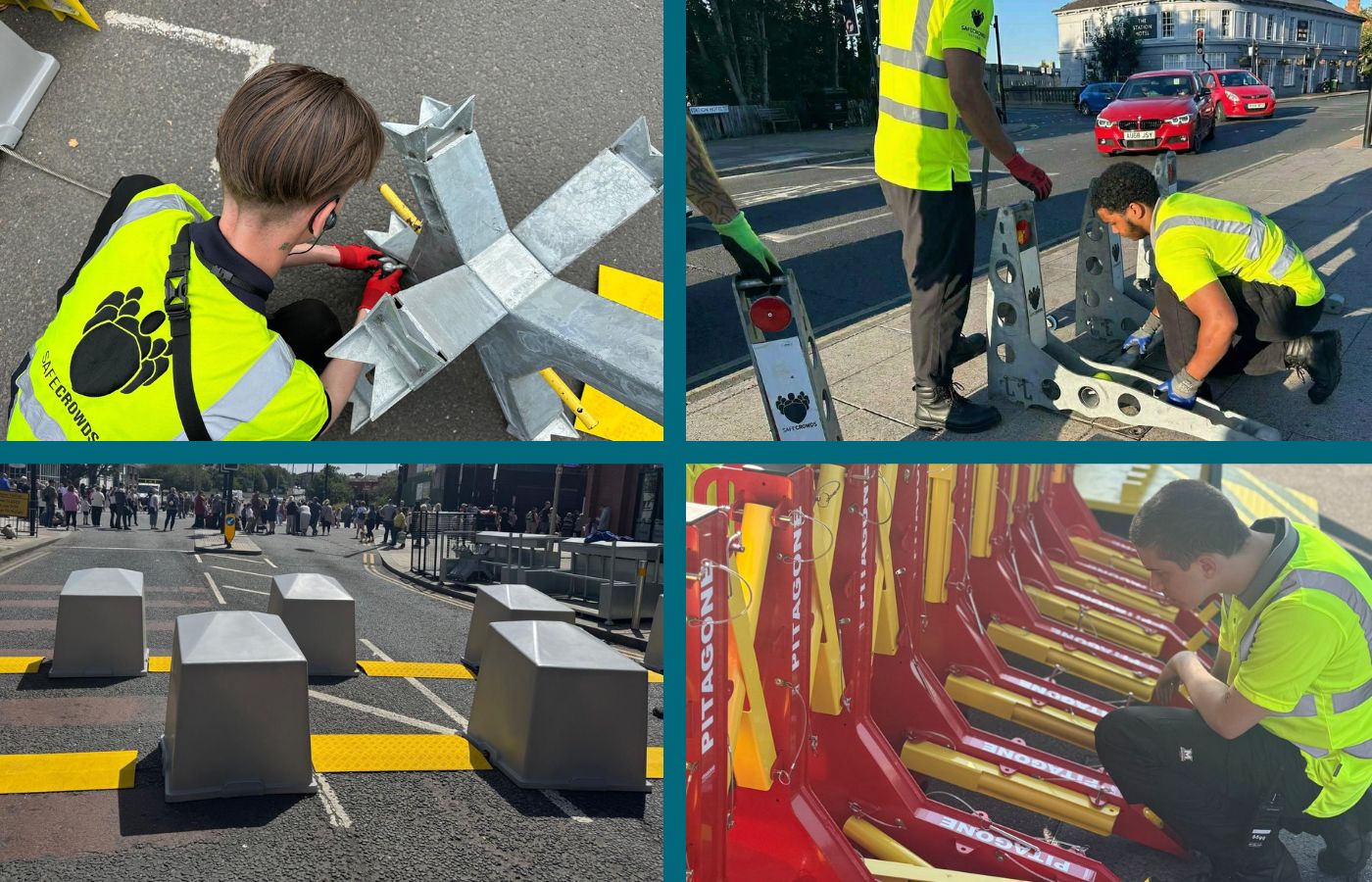
Even relatively permeable measures such as bollard arrays need careful thought. Their orientation in relation to pedestrian movement can affect how readily people move through them. Larger temporary barriers, planters and other substantial installations can have a greater impact because they remove more usable space and may force flows around them.
Location is therefore as important as product selection. For example, placing HVM close to an existing narrowing, queue, crossing point or convergence of pedestrian routes can amplify a problem that already exists.
There are secondary hazards to consider too. Temporary surface-mounted systems may have elements at ground level that people need to negotiate. In a dense crowd, the people approaching them may not have a clear view of what lies ahead and poorly considered positioning can result in sudden changes of direction or hesitation which can disrupt crowd flows and cause congestion or collisions.
Designing for the busiest moment
Our crowd management professionals don’t just think about the static environment but also consider what happens over time.
For example, in a stadium Zone Ex environment, ingress may be gradual whilst egress is concentrated as soon as the match is over. A security perimeter may work comfortably while people are arriving but come under much greater pedestrian pressure immediately after the final whistle.
Understanding those scenarios before finalising the HVM layout allows protective security and crowd safety requirements to be considered together, rather than one being retrofitted around the other. Those insights should influence the type of barrier selected, its orientation, the width and position of pedestrian routes, the location of sterile areas, wayfinding, lighting, stewarding and operational procedures. With the right expertise on the team, relatively small changes in HVM barrier location can preserve the protective security objective while significantly improving crowd movement.
Bringing the disciplines together
At SAFECROWDS GROUP, our HVM capability is part of our integrated multi-disciplinary approach, which means we can consider a proposed scheme through the lenses of protective security, crowd safety and operational efficiency.
The objective of HVM should not be to create the strongest possible barrier line regardless of its surroundings. It should be to deliver proportionate protection that works with the operational reality of the site. Because proportionate HVM schemes do not simply need to stop a vehicle, they also need to protect people without creating avoidable risk in the process.