SAFECROWDS GROUP’s Co-MD, Rory McGoldrick, discusses why ensuring teams have completed accredited protective security training is an essential element of due diligence – and why SAFECROWDS GROUP has developed an accredited Level 2 HVM course to help close a potentially serious skills gap.
When you’re a security professional with more than 20 years’ experience like I am, with qualifications across multiple disciplines, taking a nosey at the security arrangements wherever you are is an occupational hazard – even on a day off!
So, when I attended a football game as a fan rather than a security lead recently, I couldn’t help checking out the HVM installation.
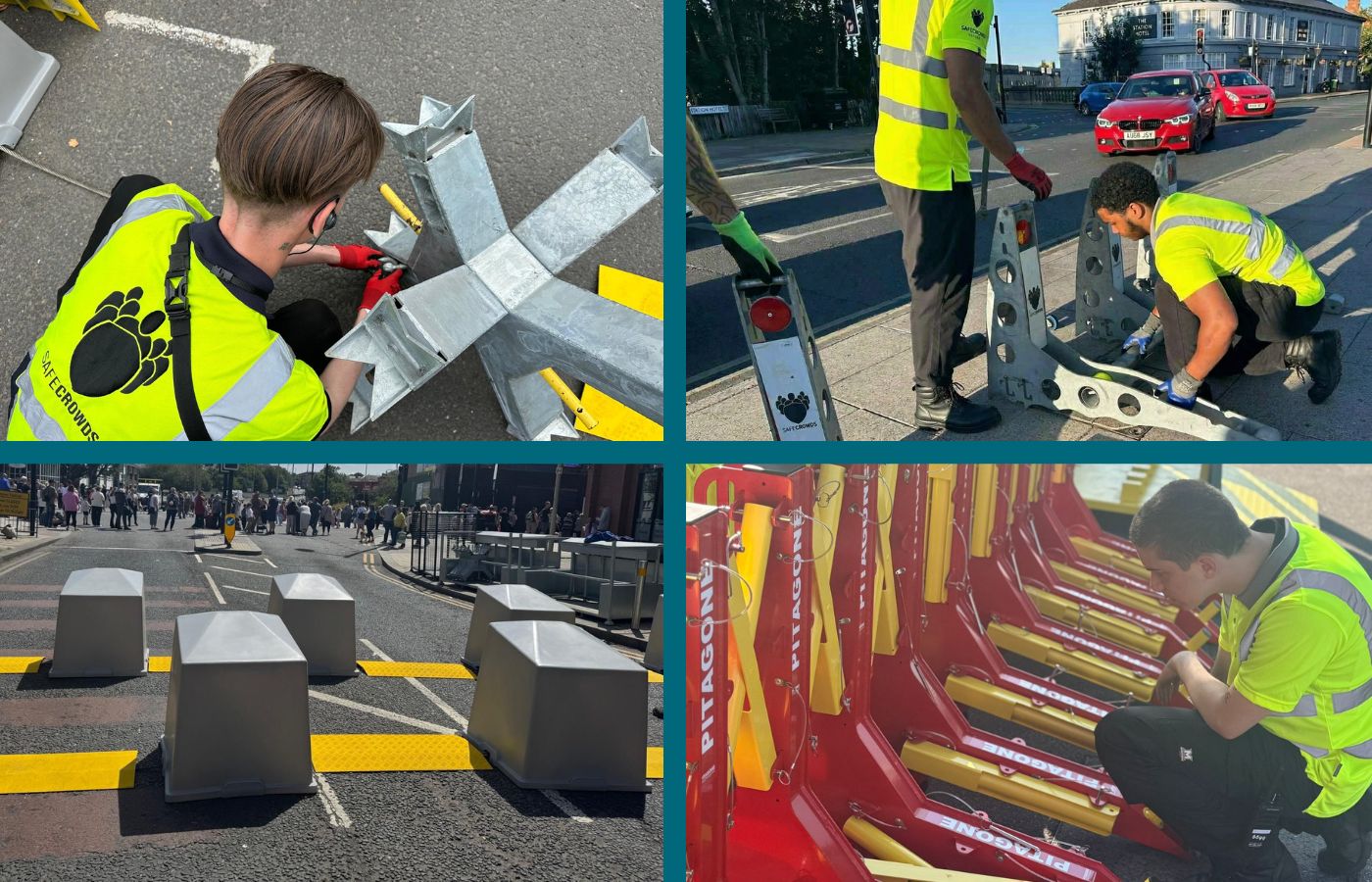
What I saw was HVM barriers deployed in the correct location to protect fans in the Zone Ex area outside the stadium. But I also noticed with dismay that the equipment had been incorrectly deployed, meaning it would not have delivered its ‘as rated’ level of protection in the event of a vehicle attack.
The installation team had failed to take a final and essential step in the installation process to lock the surface-mounted temporary HVM equipment in place. As a result, the HVM system would have been ineffective if it had been put to the test.
It was a stark reminder of why we developed SAFECROWDS GROUP’s Level 2 in Protective Planning: an Introduction to HVM. The fully online course, accredited by Highfield, is designed to give those involved in specifying, procuring, installing and overseeing HVM the foundational knowledge they need to understand vehicle threats, hostile vehicle mitigation principles and the importance of correct installation.
Because however rigorously engineered, tested and proven HVM equipment may be, it can only deliver the protection it was designed to provide if it is installed correctly.
Performance gaps
As HVM protection at sports fixtures, events and crowded places becomes more commonplace, the issues I observed on this match day raise an important point.
At the current time, there is no mandated training for HVM installers. In fact, there is no obligation to train HVM installation teams at all. Literally anyone can be given the task of installing the equipment.
In practice, most installation companies ensure that their teams have had manufacturer training, but even that only gives them a working knowledge of a particular HVM system, without necessarily providing a basic bedrock of knowledge about vehicle threats and hostile vehicle mitigation principles.
As a result, installation teams may not be equipped to question issues that arise on site due to challenges such as site conditions being different from expected or unforeseen operational requirements.
Moreover, the integrity of the installation relies on quality assurance checks carried out by the site supervisor, who will usually be experienced and able to sign off whether the HVM equipment has been correctly installed against the RAMS. But that supervisor is equally unlikely to have undergone accredited protective security training and may also lack the wider knowledge needed to respond to issues encountered on the day.
Supply chain complexity
As the protective security sector becomes increasingly complex in preparation for the obligations of the Terrorism (Protection of Premises) Act 2025 (Martyn’s Law), so too does the thread of due diligence and duty of care.
Some organisations, including sports clubs, event organisers and local authorities, may choose to buy temporary HVM equipment rather than hiring it as a turnkey service, or may continue to hire equipment but use their own in-house or subcontracted teams to install it.
In these scenarios, where does the responsibility for training and quality assurance lie? With the company that has sold the HVM equipment or hired it as a product without an installation service? With the team subcontracted to install it? Or with the decision maker who has chosen to procure the HVM system without the expertise needed for installation?
Training is an integral part of due diligence here. HVM barriers are life-saving equipment that can only deliver their intended ‘as rated’ performance if they are correctly installed, so training is critical to both procurement decisions and correct, quality-assured installation.
For the end client – the football club, event organiser, local authority etc. – evidence that installation teams have successfully completed accredited training provides an important building block of due diligence. It demonstrates that individuals given responsibility for delivering hostile vehicle mitigation have the specialist knowledge needed to understand the role the equipment plays in protecting people and the importance of correct installation.
That robust due diligence not only enhances the level of protection for members of the public, but also helps protect organisations from legal and reputational risk should the worst happen.
Accessible, affordable training
This is precisely the gap our Level 2 course has been designed to address.
Until recently, the lack of accredited protective security training specifically aimed at providing a foundational level of HVM knowledge meant it was difficult for organisations across the supply chain to give their teams easy access to the knowledge they need.
SAFECROWDS GROUP’s Level 2 in Protective Planning: an Introduction to HVM is fully online and accredited by Highfield, enabling learners to build their knowledge at their own pace. Testing takes place as they complete the modules, followed by a final assessment. Learners must achieve a score of at least 80 per cent to pass and receive their certificate, while those who do not pass can repeat the modules without paying again for the course materials.
For organisations responsible for protecting people with hostile vehicle mitigation, this means key decision makers can be trained to support a more informed procurement process. They can also require supply chain partners to ensure operatives have completed appropriate accredited training and verify that training has been successfully completed.
That requirement can form part of their due diligence whether they are working with a company that offers installation services alongside hire, a partner that installs equipment as a service provider, or their own in-house team.
Training is a key tenet of the Terrorism (Protection of Premises) Act, and the Responsible Person for premises or events that fall into the Enhanced Tier will be tasked with ensuring appropriate training has been undertaken.
No organisation would consider appointing someone as a first aider without ensuring they had received accredited training. The same principle should apply to anyone tasked with installing HVM equipment.